Not Just a Meal: Finding comfort as Pinoys through the motherland’s food (Photo Essay)
“Kain tayo!” “Mangaon ta!” “Mangan tayon!” No matter the Filipino language (from Tagalog to Cebuano to Ilocano, respectively), it only takes a few words for a Filipino to invite their friends and loved ones to a shared meal: “let’s eat.”
The following photos are from a photo essay showcasing a meal shared between a few Pinoys (meaning “Filipinos,” colloquially). On February 18, I had the chance to sit down with Emi Bague, Associate Director at International Student Career Services at Emerson College, and her child Mika Wieczorek (two Filipinos based in the Greater Boston area) for a meal at Bright Light, a restaurant in Quincy, MA that serves Jamaican and Filipino cuisine.
With the recent closing of Tanam in Somerville, Bright Light is currently the only brick-and-mortar Filipino food business in the Greater Boston area. Food does not just equate nourishment for Pinoys–it serves as a way of building community, bonds, and love over the intimacy of sharing a meal.

One of the first items we ordered for our meal was pancit palabok, a popular noodle dish among Pinoys. It is known for its yellow-orange sauce (made from pork and shrimp) layered on top of rice noodles, and served with various toppings such as hard-boiled eggs, scallions, and minced meat.
“I associate pancit palabok with trips to the Philippines,” Bague said. “Whenever you would go to a shopping mall and they'd have a food court, you could buy pancit palabok at a food court, which I loved.”
It was a given that we had to order chicken adobo, as it is a quintessential Filipino dish–it makes for great baon (leftovers) when served alongside rice. Filipino chicken adobo is prepared by marinating chicken pieces in soy sauce and an array of spices, pan-frying the chicken, and stewing until tender.
“I remember my mom cooking adobo at home,” Bague recalled. “She'd have this giant chopping knife–the heavy one–and then a chicken leg, and she'd just slam that thing down on the cutting board. I remember that eating adobo with a fork and a spoon is the only way to do it. You hold your fork in your non-dominant hand, hold down your chicken, and peel the meat off of it.”


A personal request of mine was ordering lechon kawali, or crispy pork belly. This dish provides great sustenance when paired with fresh white rice and dipping sauce (usually made of a mixture of soy sauce, vinegar, and onions).
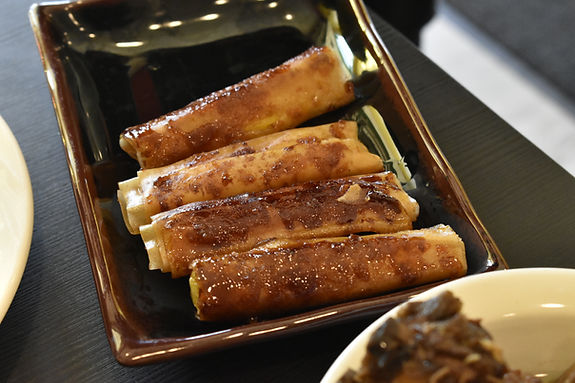
Typically served as merienda (snack) or dessert, turon are deep-fried banana rolls, a twist on the popular appetizer, lumpia (fried spring rolls).
“I was talking to one of my friends and colleagues at Emerson and she said how she likes to fry plantains,” Bague said. “I said, ‘Wrap it up in an egg roll wrap, then fry it, then caramelize some sugar and drizzle it over there, and you will have Filipino food in your mouth.’”

The name directly translating to “mix mix,” halo halo is a staple Pinoy dessert with its variety of colors showcased through its serving bowl. From the purple of the ube (purple yam) ice cream to the red and green jellies to the richness of the red beans, halo halo is a burst of colorful flavors that is essential for the end of any Filipino meal.
*From left to right: Emi Bague, Mika Wieczorek
With a spread as big as this, it was inevitable that we needed a few boxes to take the rest of this food out. Not only is a Filipino meal healing for those who crave the taste of home (especially those away from the motherland and Pinoys away from family), but it also serves as a full-on sensory experience as one immerses themselves in that intimacy and flavorful experience.
“The thing about food is that it involves all of your senses,” Bague explained. “You see it, you smell it, you hear it being made or you crunch into it. You touch it–[the] kamayan tradition of eating with your hands. The hearing–the crunch. All of those things put together connect you to memories. Memories of traditions here, visits to the Philippines, and what it feels like to have the same food there at like 11:00 at night.”


A line of Filipino flags along the walls of Bright Light
Places such as Bright Light have served as pockets of home for Pinoys in Boston; it brings the simplicity of feeling at home even for a little bit of time through a meal full of a Pinoy’s favorite dishes.
Though Bague has found community and celebration of Pinoy heritage by being the advisor for ASIA (Asian Students in Alliance) at Emerson, and through her work and involvement at Iskwelahang Pilipino, a Filipino cultural school based in Bedford, she still wonders what it would be like to grow up and be in a space where Filipinos weren’t a minority in a community’s ethnic demographic.
“Maybe I wouldn't forget the names of these snacks if I was surrounded by this community of Filipinos regularly, not just when we get together for community events here, which is like every other week or less, but every day,” Bague explained. “That would be huge–an alternate reality.”
To read more about the struggle of finding a Pinoy community in Boston while Pinoy cuisine is slowly entering a place in America's culinary scene, click here.